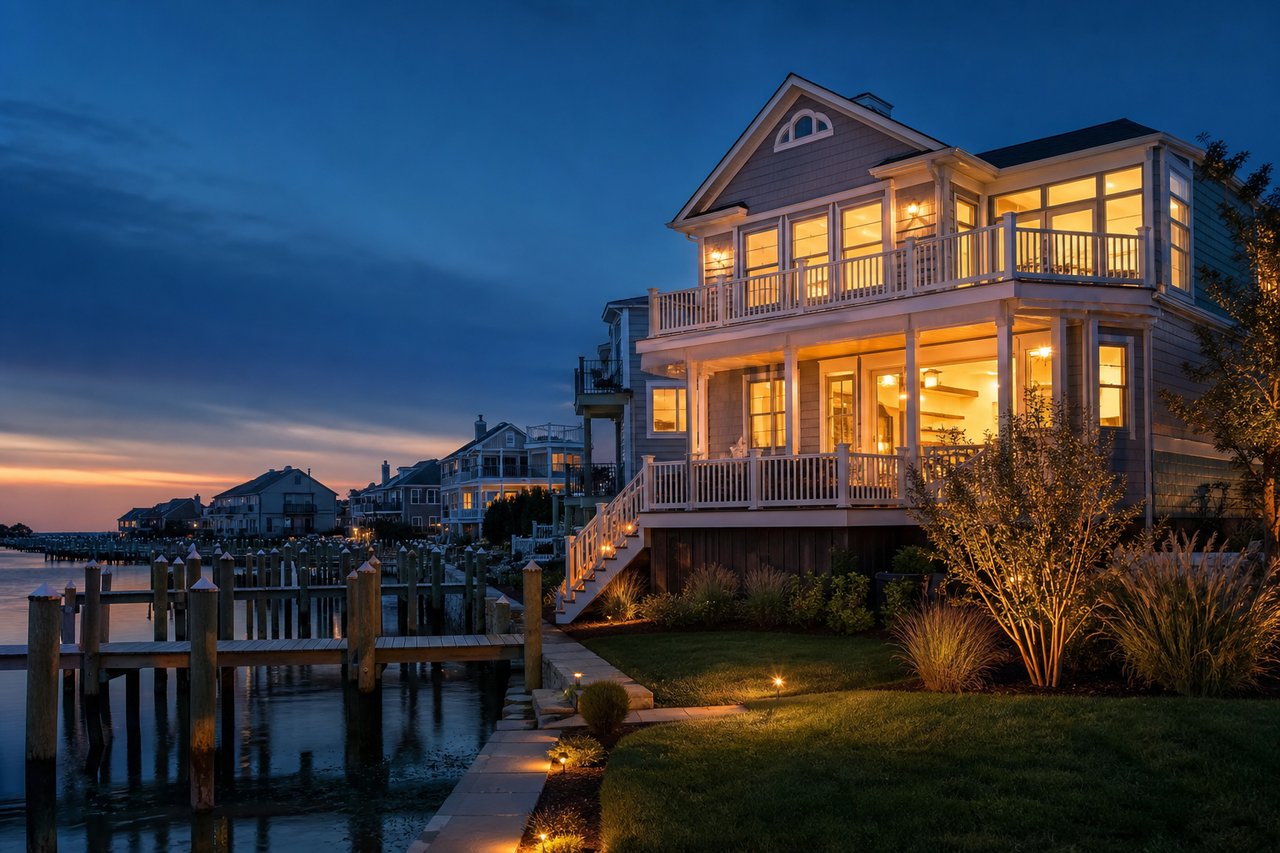
What is bayfront living actually like in Coastal Southern New Jersey?
Bayfront living in Coastal Southern New Jersey means protected-water recreation, west-facing sunsets, and a pace that's noticeably different from the oceanfront. Whether you're looking at a tidal creek in Cape May, a back-bay lot in Ocean City, or a Delaware Bay-facing stretch in Lower Township, the lifestyle is defined by calm water, direct access to crabbing and kayaking, and the kind of quiet that's hard to find on the Atlantic side. The trade-off is real too: flood exposure, dock feasibility, and water conditions vary significantly from one shoreline to the next, so neighborhood-level research matters before you fall in love with a listing.
Key Takeaways
- Cape May County's bay waters support back-bay crabbing, kayaking, boating, water skiing, personal watercraft, parasailing, and fishing, according to Cape May County.
- Cape May sits where the Delaware Bay meets the Atlantic Ocean, giving bayfront residents access to both protected bay waters and open-ocean recreation nearby.
- Sunset views are not automatic on every bayfront property, Delaware Bay-facing and west-facing waterfronts get them; east-facing Atlantic lots get sunrises instead.
- Coastal flooding is a real planning factor: the National Weather Service tracks flood conditions at Stone Harbor, Cape May Harbor, the Delaware Bay at Cape May, and Sluice Creek in Dennis Township.
- "Bayfront" covers tidal creeks, back bays, harbors, lagoons, and open Delaware Bay shoreline, each one differs in boating access, wave exposure, dock feasibility, and flood risk.
How does the bay experience differ across Coastal Southern New Jersey towns?
This is the question I walk every bayfront buyer through first, because "bayfront" isn't one thing down here. The experience at a tidal creek in Cape May is completely different from a back-bay canal in Ocean City or a wide-open Delaware Bay shoreline in Lower Township. Here's how I break it down for clients.
Cape May and Cape May Harbor
Cape May is where the Delaware Bay meets the Atlantic Ocean, which gives it a water experience unlike anywhere else in the region. You have Cape May Harbor, Cape Island Creek, protected back waters, and open-bay exposure all within a short distance of each other. That variety supports kayaking, small-boat outings, crabbing, and wildlife paddling, but it also means water conditions shift with wind, tide, and which side of the harbor you're on. The NOAA Cape May Harbor gauge is updated continuously, which tells you something about how seriously local mariners track conditions here.
Lower Township and the Delaware Bay Shore
If sunsets are what you're after, the Delaware Bay-facing shoreline west of Cape May is where you want to look. These properties sit on calmer water, face west by nature, and tend to offer a quieter setting than the barrier island towns. The trade-off is that you're farther from the ocean beach scene, and access to boat ramps or launch points is municipality-specific, you'll want to verify what's actually available for a given property before assuming you can pull a boat out of your backyard.
Ocean City and the Back Bays
Ocean City's back-bay side is a different rhythm entirely. The protected water supports kayaking, stand-up paddleboarding, sailing, and catamaran outings. You're not getting ocean swells, but you're also not fighting them. The sunset views are real from the west-facing bay side, and the access to the broader Jersey Cape's waterfront recreation, which stretches from Atlantic beaches to Delaware Bay shorelines, means you're never far from a different kind of water experience. I've written a deeper breakdown of what bayfront ownership specifically looks like in Ocean City if you want to go further: Bayfront Living in Ocean City, NJ: What to Know.
Somers Point and the Mainland Bayside
Somers Point sits on Great Egg Harbor Bay and gives buyers a mainland bayfront option that's often overlooked. The lifestyle here is genuinely water-oriented without the barrier-island price premium. If you're weighing island versus mainland, that's a trade-off worth thinking through carefully, and I'd point you to Bayfront Homes in Somers Point NJ Worth Knowing for a closer look at what that market actually offers.
Shoreline Type | Water Character | Sunset Views | Primary Recreation |
|---|---|---|---|
Delaware Bay (Lower Township, Cape May west side) | Open bay, wind-exposed | Yes, west-facing | Boating, fishing, crabbing, sunsets |
Cape May Harbor / Cape Island Creek | Protected harbor, tidal creek | Varies by lot | Kayaking, small boats, crabbing, wildlife |
Ocean City Back Bay | Protected back bay, calm | Yes, west-facing lots | SUP, kayaking, sailing, crabbing |
Somers Point / Great Egg Harbor Bay | Bay, mainland-adjacent | Yes, west-facing lots | Boating, fishing, kayaking |
Tidal Creek / Lagoon | Narrow, tide-dependent | Varies by orientation | Kayaking, crabbing, small skiffs |
What do buyers need to know about flood risk and practical bayfront ownership?
I'm not going to gloss over this part. Bayfront ownership in Coastal Southern New Jersey is genuinely wonderful, and it comes with real responsibilities that every buyer should understand before making an offer.
Coastal flooding is a planning factor, not a dealbreaker
The National Weather Service's Eastern Region actively monitors coastal-flood conditions at Stone Harbor, Cape May Harbor, the Delaware Bay at Cape May, and Sluice Creek in Dennis Township. That's not a reason to walk away from bayfront property, it's a reason to do your homework on the specific parcel. Elevation, flood-zone designation, flood-insurance requirements, access-road vulnerability, and local drainage conditions are all property-specific. What applies to one lot on a block may not apply to the next one.
Dock access, wetlands, and water depth are not guaranteed
A bayfront address doesn't automatically mean you can put in a dock, launch a boat, or pull up in anything with a motor. Tidal wetlands, dredging conditions, water depth at low tide, and municipal or state permitting all factor in. If boating access is a priority for you, I'll tell you directly: verify it at the property level, not the neighborhood level. The New Jersey DEP's municipal access planning materials show how granular these designations get, kayak and small-boat access is designated at specific street ends, not along an entire shoreline.
Public access points vary by town
Beach-tag rules, boat ramps, street-end launches, and shoreline regulations differ among Cape May, Lower Township, Ocean City, Sea Isle City, Avalon, Stone Harbor, and other communities. According to the NJ DEP, Cape May's beach tags apply to beachgoers age 12 and older during the in-season period from Memorial Day through Labor Day during specified daytime hours, but that's Cape May's rule specifically, not a countywide standard. The right move is to verify the rules for the municipality where you're buying, not assume they match the town next door.
The off-season is real, and worth thinking about
Cape May County's recreational scene is seasonal in the way that the county's own boating and fishing resources reflect. That doesn't mean bayfront living goes dark after Labor Day, plenty of buyers choose these properties specifically for the quieter fall and winter months. But if you're buying as a primary residence, you should picture the property in February, not just July. The lifestyle is different, and for a lot of people, it's still exactly what they want.
Every bayfront situation is different, and the only way to know what a specific property actually offers is to look at it closely with someone who knows this market. That's exactly the kind of analysis I do before my clients make an offer.
If you're also weighing whether to buy an existing bayfront home or build new, the trade-offs on the coast are worth a separate conversation, I've covered that in detail at Buy or Build in Coastal Southern New Jersey.
Thinking about what bayfront living looks like in practice? Read what clients have said about working with me on Google, Zillow, and Realtor.com.
FAQ: Bayfront Living in Coastal Southern New Jersey
What is the difference between living on the bay and living on the ocean in Southern New Jersey?
Ocean-facing properties in Southern New Jersey front the Atlantic directly, with surf access, east-facing sunrise views, and higher wave energy. Bayfront properties, whether on the Delaware Bay, a back bay, harbor, or tidal creek, offer protected water, calmer conditions, and typically west-facing sunsets. The lifestyle priorities, flood profiles, and recreational options differ meaningfully between the two, and so does the market.
Which Coastal Southern New Jersey towns have the best bayfront sunset views?
West-facing and Delaware Bay-oriented shorelines deliver the most consistent sunset views. Lower Township and the Delaware Bay side of Cape May are naturally positioned for them. Back-bay lots on the west side of Ocean City, Stone Harbor, and Avalon also face west and catch strong sunsets. The actual view from any given property depends on shoreline angle, neighboring structures, marsh vegetation, and docks, so it's worth visiting at dusk before you commit.
Can I kayak or paddleboard directly from a bayfront home?
It depends on the specific property. Some bayfront homes have direct water access from a dock or bulkhead; others are separated from the water by tidal wetlands, marsh grass, or a seawall that doesn't permit easy launching. The NJ DEP's access planning materials show that even in Cape May, kayak launches are designated at specific street ends rather than along the entire shoreline. Verify access at the property level, not just the neighborhood level.
What should I know about coastal flooding before buying a bayfront home?
Coastal flooding is a real planning factor for bayfront properties in Southern New Jersey. The National Weather Service monitors flood conditions at Cape May Harbor, Stone Harbor, the Delaware Bay, and nearby tidal locations. Before buying, review the specific parcel's elevation, FEMA flood-zone designation, flood-insurance requirements, access-road vulnerability, and drainage conditions. These are property-specific details, not neighborhood generalizations, and they directly affect your insurance costs and long-term ownership experience.
Is bayfront living in Cape May County practical year-round or mainly seasonal?
Bayfront living is practical year-round for buyers who want it to be. The recreational season is concentrated from late spring through early fall, but many bayfront owners specifically value the quieter off-season months for the privacy and pace they offer. If you're buying as a primary residence, picture the property in the off-season as much as in summer, the lifestyle is genuinely different, and for the right buyer, that's part of the appeal.
Are bayfront properties in Southern New Jersey suitable for boating and crabbing?
Many are, but not all. Cape May County's waterways support back-bay crabbing, boating, water skiing, personal watercraft, and fishing, but a specific property's suitability depends on water depth, dock feasibility, tidal wetlands, and any applicable municipal or state permitting. A tidal creek lot and an open-bay lot are very different in practice. Verify the specifics of the property you're considering, not just the general reputation of the area.
The bottom line on bayfront living at the Jersey Shore
Bayfront living in Coastal Southern New Jersey is one of the most rewarding lifestyle choices I help clients make, and it's also one of the most nuanced. The right bayfront property isn't just about the view; it's about matching the specific shoreline, water access, and flood profile to the life you actually want to live here.
If you're ready to start that conversation, reach out directly at [email protected]. And if you want to see what the shore lifestyle looks like up close before you decide, watch the show at Saltwater Living on YouTube.
Equal Housing Opportunity. Christopher Oliva is licensed in New Jersey as a Broker/Salesperson, regulated by the New Jersey Real Estate Commission (NJREC). This article is general information only and does not constitute legal, tax, or financial advice. Confirm all property-specific details, including flood-zone designation, insurance requirements, and access conditions, with your title company, tax advisor, or lender.