What should buyers know before purchasing new construction at the Jersey Shore?
Before you buy new construction at the Jersey Shore, get five things in writing: a completion date with an outside deadline, priced change orders and allowances, the New Jersey new-home warranty plan, an independent inspection schedule, and your flood elevation and certificate-of-occupancy documents. A brand-new home can still have drainage, flashing, or workmanship problems, so inspect it the way you would inspect any other home.
Key Takeaways
- New Jersey requires builders to register before they start construction of a new home and before they offer a warranty on a new home sold in the state.
- The state warranty framework generally provides one year of coverage for workmanship and materials, two years for plumbing, electrical, heating, and cooling delivery systems, and 10 years for major construction defects, all running from the warranty date.
- A builder's warranty does not replace your own independent inspection of the structure, drainage, roof, flashing, windows, mechanical systems, grading, and finishes.
- In New Jersey flood-hazard areas, an elevation certificate is required during construction before further vertical construction and again before occupancy.
- Your contract should state whether closing can happen without a final certificate of occupancy and what happens if that certificate is delayed.
I walk buyers through new construction up and down the shore, from the barrier islands to the mainland towns along the bay. New construction on the island carries a premium, and for buyers who don't want to take on a renovation, that premium can be well spent. But the premium buys you a newer house, not a guarantee. What protects you is the paper you sign and the inspections you order. For a broader look at the island market, see my post on new construction at the Jersey Shore.
How do completion dates, change orders, and allowances work in a Jersey Shore new-construction contract?
They work exactly the way your signed contract says they work, so each one needs to be defined in writing before you sign. Marketing brochures and model-home conversations don't control anything unless they're incorporated into the agreement.
Can a builder move your completion date after you sign?
Yes, if the contract allows it, so read the extension language closely. Completion dates are contract terms, not promises you can assume.
Look for these items:
- A defined estimated completion date
- An outside date (sometimes called a drop-dead date)
- The specific reasons the builder may extend the schedule
- How and when the builder must give you notice
- Your remedies if the date moves past the outside date
Weather, permitting, inspections, utility connections, material availability, subcontractor scheduling, site conditions, and flood-related approvals can all push a schedule. I don't quote a universal construction timeline, because no two builds run the same. What I do tell buyers is not to tie a hard move-out date, lease end, or sale closing to the builder's estimate without a backup plan. If you're also selling a home, my post on selling before you buy in Coastal Southern NJ covers how to think about that overlap.
What should the contract's specifications cover?
The specifications should spell out what is included and what is optional, and they should say which document controls if marketing materials conflict with the signed specs. Here is what I look for:
Contract item | What to confirm in writing |
|---|---|
Plan and site | The model or plan, the site plan, and any structural options |
Finishes and appliances | A finish schedule listing brands, models, and materials |
Exterior and site work | Landscaping, drainage, utilities, driveway, decks, pools, and seawalls or bulkheads where applicable |
Controlling document | Which document wins if marketing materials and signed specs disagree |
Certificate of occupancy | Who obtains it and whether closing can occur without it |
Warranty | The warranty plan, the warranty date, and claim instructions |
How should you handle change orders?
Get every change order in writing, with a price, before any work proceeds. Verbal promises made on a model-home tour are not contract terms unless they end up in the signed agreement.
- Find out who can approve a change order on each side.
- Ask whether you receive a credit for items you delete.
- Ask how builder markups are handled on upgrades.
- Ask whether an upgrade changes the completion date.
Is an allowance a credit or just a budget?
It depends on the contract language, and that is where buyers get surprised. An allowance may be only the builder's stated budget for something like flooring, cabinets, lighting, plumbing fixtures, or landscaping. Confirm whether installation, delivery, taxes, design fees, and builder overhead are included. Then confirm what happens if your selection comes in under the allowance and what happens if it comes in over.
What your own selections will add up to depends on your choices, and that is a conversation I'd rather have with you before you sign than after.
What does the New Jersey new-home warranty cover, and why should you still inspect new construction?
The New Jersey warranty covers specified defects under state standards, but it is not a substitute for your own inspection. The state's consumer materials are clear that the warranty program addresses covered defects, while an independent inspection looks at the actual condition of the home before you close. You can read the state's consumer information for new home buyers to see how the program is framed.
What are the warranty periods?
Builders must be registered with the state before starting construction of a new home and before offering a warranty on a new home sold in New Jersey, according to the Department of Community Affairs. The state's New Home Warranty Program homeowner's booklet describes the general coverage periods:
Coverage area | General warranty period |
|---|---|
Workmanship and materials | 1 year |
Plumbing, electrical, heating, and cooling delivery systems | 2 years |
Major construction defects | 10 years |
Appliances | Generally limited to the manufacturer's warranty |
These periods run from the warranty date, not from the day you notice a problem. Make sure your contract identifies that date clearly, and collect the warranty certificate, the plan, the effective date, the builder's registration information, and written claim instructions at or before closing.
"Under warranty" is not enough. The state's list of approved new home warranty plans uses performance standards, so get the specific plan and read its exclusions, claim procedures, dispute process, and deadlines.
Which inspections make sense on a new build?
Use several inspections instead of relying on the final walk-through alone. A practical sequence looks like this:
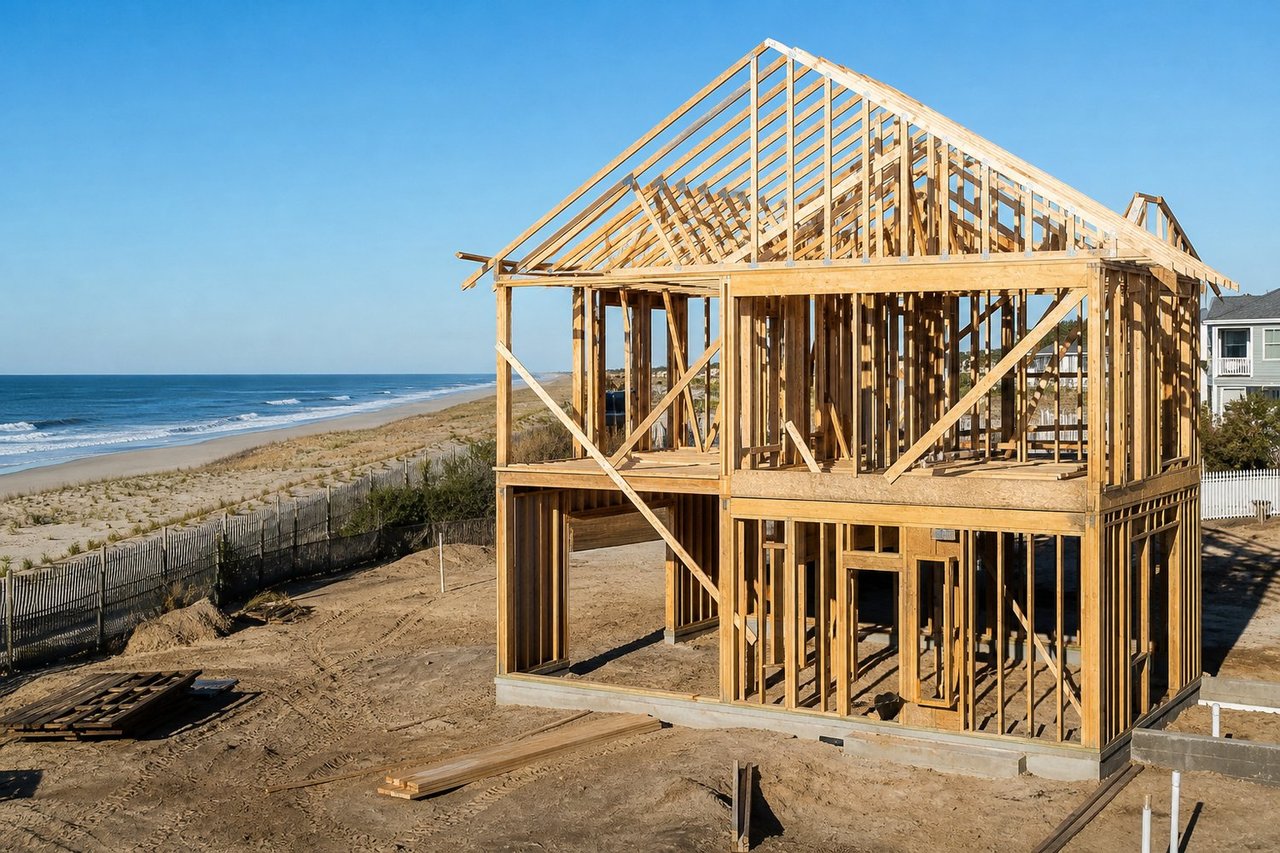
- Pre-drywall inspection, while framing, wiring, and plumbing are still visible.
- Framing or structural inspection, where appropriate for the build.
- Systems inspection of mechanical, electrical, and plumbing.
- Final inspection before closing.
- Post-closing warranty inspection, before the first warranty deadlines expire.
Hire an inspector who is independent of the builder and qualified to evaluate coastal construction, drainage, moisture intrusion, flood-resistant construction, and elevation documentation. A new structure can still have settlement, drainage, flashing, installation, or workmanship defects.
What should an inspector look at on a coastal lot?
Water management comes first. Have your inspector check:
- Grading, swales, and foundation drainage
- Sump or drainage systems and retaining structures
- Crawl spaces and under-deck areas
- Exterior penetrations, roof-to-wall intersections, and flashing
- Windows and doors
- The transition between your lot and neighboring properties
Before closing, photograph unfinished items, record serial and model numbers, and collect manuals and permits. Attach a detailed punch list to a written agreement that says which items remain open, who will complete them, and by what date. Review the contract's specific remedy and escrow language for incomplete work, because it varies from builder to builder.
How do flood elevation and certificate-of-occupancy timing affect a Jersey Shore closing?
They can decide whether you can close and move in, and they can affect design and insurance. Both are worth settling in the contract before construction is far along.
What are the flood and elevation requirements?
In flood-hazard areas, New Jersey's rules at N.J.A.C. 7:13 can require the lowest floor of a single-family home or duplex to be at least one foot above the applicable climate-adjusted flood elevation, and no lower than the elevation required by the Uniform Construction Code. The elevation that applies depends on the site, the flood zone, the permits, and the rules in effect when the project was approved.
The DEP's Flood Protection Area Guidebook ties elevation documentation to construction inspections: an elevation certificate is required during construction before further vertical construction and again before occupancy. That makes it an important closing and insurance item.
For a property in or near a regulated flood-hazard area, request the approved plans, flood-zone information, foundation or elevation documentation, permits, and any conditions imposed by the municipality or the DEP. Whether your lot is in Ocean City, Avalon, Stone Harbor, or a mainland town like Somers Point or Linwood, confirm its status with the municipality rather than assuming. Talk with your insurance agent early about how the elevation documents affect your coverage.
What happens if the certificate of occupancy is delayed?
It depends on your contract, which is why the contract should address it before you sign. A construction permit is required for new construction, and the construction official issues a certificate of occupancy after the required work is completed, applicable conditions are met, and fees are paid, per the state's Uniform Construction Code overview. The certificate is meant to verify that the permitted work was completed in accordance with the code, as the DCA's certificate of occupancy guidance explains.
Confirm these points in writing:
- Who is responsible for obtaining the certificate
- Whether temporary or partial occupancy is permitted
- Whether utilities must be active before issuance
- Whether the contract allows closing or possession without the final document
- What your options are if the certificate is delayed
Your title company handles the closing itself, but those terms have to be in your contract before you get there.
Want to see what other buyers and sellers say about working with me? You can read reviews on Google, Zillow, and Realtor.com.
FAQ
How long does new construction usually take at the Jersey Shore?
There is no single timeline that applies to every build. Weather, permitting, utility connections, site conditions, and flood-related approvals all affect the schedule. Get an estimated completion date and an outside date in the contract, and plan your move with a backup.
Can a builder change the completion date after I sign the contract?
Only to the extent your contract allows. Check the permitted extensions, the notice requirements, and your remedies if the date passes the outside date. These terms vary by builder, so read them before you sign.
Should I get an inspection on a brand-new coastal home?
Yes. A new home can still have drainage, flashing, installation, or workmanship defects. Use an independent inspector who is qualified in coastal construction, and consider inspections at pre-drywall, systems, and final stages, plus one before the first warranty deadlines expire.
What happens if the builder cannot get the certificate of occupancy before closing?
That depends on what your contract says about closing and possession without the final certificate. Confirm who is responsible for obtaining it, whether temporary or partial occupancy is allowed, and what happens if it is delayed. Settle these terms before you sign.
Who pays for upgrades, change orders, and costs above construction allowances?
Under most builder contracts, costs above an allowance fall to the buyer, but your contract controls. Confirm whether the allowance covers installation, delivery, taxes, and design fees, and get every change order priced in writing before work begins. I'm glad to review the terms with you.
The core takeaway is that new construction at the Jersey Shore rewards buyers who put every term in writing and inspect before closing. If you're weighing a new build, I'll go through the contract language, inspection timing, and elevation paperwork with you before you commit. Contact me at [email protected], or watch the show to see the shore through my eyes. If you're still deciding between building and buying, start with my post on buying or building in Coastal Southern New Jersey, or see what buyers should know about new construction on NJ barrier islands.
Equal Housing Opportunity. Christopher Oliva, Broker/Salesperson, Compass RE, licensed in New Jersey and regulated by the New Jersey Real Estate Commission (NJREC). This article is general information, not legal, tax, or financial advice. Confirm your own contract terms and numbers with your title company, tax advisor, insurance agent, or lender.